Chapter 22
Samia had woken up early to do her morning prayers, something that became easier as she got older. The little pains eased when she was doing her woodoo but she had started massaging rather than washing so it would make sense that the pain eased. When she was almost finished she heard the door being opened and then very quietly closed. This was very early in morning, before sunrise so the noise was out of place. She left the bathroom to find her young thirteen year old grandson coming up the stairs.
Startled, she asked:
'You've come back home just now?'
'Yes,' he whispered, smiling.
She studied him for a moment and looked away.
'Come pray with me.'
'Of course,' he answered without hesitation.
'Go do your woodoo and come downstairs.'
He went into the bathroom while Samia went down the stairs to the living room forgetting that she hadn't completed hers.
The boy came down, his hair still moist.
'Usually a woman doesn't lead a prayer for boys, but needs must. There's no one here to lead you.'
'Thank you, grandmother.'
'Do you know your prayers?'
'Yes.'
She looked at the smiling boy and thought that he might be lying but said no matter. The ceremony would be good enough for now.
They prayed and Samia forcefully, clearly, enunciated the calls.
'Are you tired?' Samia asked Abdi when they had finished praying.
'A little,' he answered. His head reached no greater than her chin.
'Sit down then,' she ordered. Her beads were on the table and she picked them up.
'Do you miss your father?'
Abdi's smile fell off his face.
'I don't know.'
'A child is a reflection of their parents,' Samia mused, 'and yours is so restless....when your mother and father married, I thought that it would be a good match. He was from a closely related tribe, so I thought that he had the same views, but I didn't expect it to be like this. Although he did have the same view, it was a world view. Your grandfather, both of them, all of them, had more than one wife, but were more local rather than global - at least they were around, if you see what I'm saying. They lived in the same village, so could be called upon to lead prayers. But your father took things to the extreme, a different type of family man; a traveling family man with families in different countries. Do you like to travel?'
Abdi had been watching her in mild bewilderment but answered firmly.
'I've never traveled before in my life.'
'How come you didn't go to your brother's trial?'
Abdi stiffened.
'I had to go school.'
'Education…the most important thing, the right education that it is. Was your brother around when he was free?'
'What do you mean?'
'Did you see him a lot around the house?'
There was a momentary pause so that the boy could consider the question.
'I used to see him around.'
'Did he tell you what to do?'
'No.'
'Do you tell your brothers and sisters what to do?'
'No.'
'And why not?'
'Why?' Abdi was taken aback. 'These aren't my kids. How can I tell them what to do?' He laughed a little. 'You mean, tell them to sit still, don't do that, do this?'
'Yes. Right and wrong.'
'No, never. I tell them not to touch my stuff. That's it.'
Samia smiled.
'I used to tell my little brothers and sisters what to do all the time, and I'm talking about right and wrong, since I was six. You're tired. Go to sleep.'
'Good night, grandmother.'
'God grant you dreams of purpose.'
Abdi rested his look on his grandmother for a moment and then left. When Samia was alone, she considered the family structure. It was true what she had said. She used to discipline and instruct her younger siblings like her older siblings had done with her to the point where she could be left alone with her younger siblings even by the time she was six when her younger siblings were toddlers. It thrilled her thinking of how she shed childhood when such a young child still, a vision of authority and moral precedence before even preadolescence. She enjoyed telling her younger siblings to sit still expending all her own childish energy in curtailing the childish energy of those younger than her. She did this with all her younger relatives, even cousins. The times she slapped one of her younger relatives for something outlandish! Vexedly tying her little head wrap tighter at five years old right after giving her little sister a beating for not sitting still and then threatening all the other kids with the same. As far as she knew that happened in all households in Somalia. It would serve to take the weight off the mothers who had many children whose fathers may not be there beyond breakfast and dinner time. But in her daughter's household it was different. Kids were allowed to be kids where all the burden rested upon the mother. She decided that before she left, she would see if she could get these kids to start correcting the younger ones. A snap, a slap or even a threat. This house had a cultural vacuum in her mind, and she would try to fill it in her wake, and try to make these children find out that there is real pleasure in correcting a child especially if you're a child yourself.
Chapter 23
When Xemi returned home he found a tearful Emily with news to tell. Her boyfriend had travelled to Kazakhstan but when he tried to return, immigration officials had detained him.
'I called the BBC to see if they could do something but they didn't reply back!'
'The BBC?' Xemi repeated incredulously. 'What can they do?'
'Maybe they can show it on the news...I don't know. I didn't know what to do!'
After the BBC, she had engaged a lawyer who had demanded more than a thousand for one letter. She had been waiting ever since. As Xemi saw her distress he said to her:
'Shouldn't we take this opportunity...'
She made a pitiable sound. He laughed. They went to his bedroom.
The lawyer's letter succeeded and her boyfriend was back on the fourth day. He looked shaken and greeted Xemi with a forced smile and a soft handshake. All three were in their bedroom while Xemi took a glance around. It was the first that he was in this bedroom strangely enough but he found nothing crazy though his heart raced slightly as he scanned the clean, grey room like a surgery theatre which he felt was strangely free of traces of blood.
Ahmed, sitting in a computer chair with Emily on the arm rest and Xemi standing in front of them, told of how he went to Kazakhstan for his brother's marriage. Emily didn't go because the two weren't married yet and it was frowned upon to bring a woman to a family function unless she was a wife. When he came back, airport officials invited him to a special office. They harassed, interrogated him, ceaselessly asking him why he came to the country.
'They called me motherfucker,' he said as final proof of their baseness, rapidly blinking away tears that will-power prevented from falling. 'Some Indian woman wearing her country's dress. She kept calling me motherfucker.'
'Now why would an Indian woman like that be harassing people?'
'Suspicious motherfucker she kept calling me. Suspicious motherfucker. Why motherfucker?'
'Why wear the traditional dress?'
'We don't know why; she's a bitch. That's why!' Emily shouted.
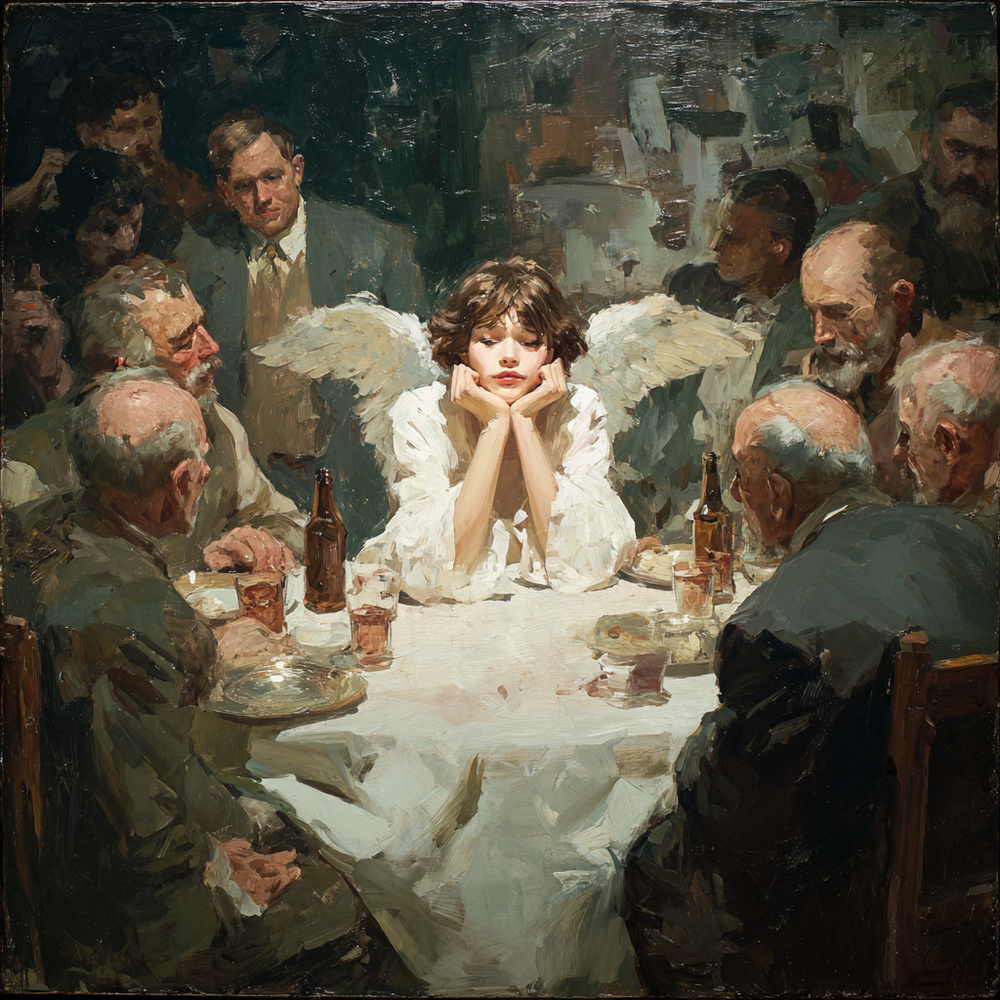
A particular rage, a riotous immigrant anger, was aroused in Xemi and demanded action. Emily's fury was palpable, not taking her eyes off her lover with her face bloodless, and her lips twitching oddly. Her little fingers were curled into a fist. Was this how an angel looks when, first confused, then concentrated, it experiences the most grievous of emotions and utters her first curse? Xemi glanced at her white almost translucent knuckles with the faintest of green veins popping and recalled the grip that she had when she was squeezing his ass, giggling every time she grabbed it and tensed at the memory. She was stronger than she looked.
'These people need to be in prison,' Xemi muttered. 'Especially that Indian woman with the dress from her country, acting like she's one of us when she…'
As ever when one wishes to exact justice but is unable to do so, one will find other ways to vent and soothe a mutinous spirit. In his room, Xemi could hear at increasing rates the cries of a beaten woman who he knew was a great secret keeper. Did she give her body up to soothe his raucous emotions and provoke him so he could find some release for tempests better spent without than within ? Did she find a similar release in her own beatings?
These conflicts started with the whine of Emily's voice, then her raised voice and then her cries which were introduced so sharply that it could only have come after some physical intervention. In this sequence, always the same, Ahmed's voice was never heard.
Was it that the love was so great that whatever clashes there were, the ring of love that surrounded them would not break and allow them to leave each other, no matter what happened within? Whatever it was, Xemi's sensibility could not abide much more. The maddening thing was that the greater the frequency of fights between them, the more they talked of marriage.
*
'The next beautiful Somali girl I see, I'll sing to, I'll sing the Somali anthem!' Xemi told King, certain he would never have to sing it. He only knew the first words and anyway that's all he would be able to manage before dissolving into laughter. He was shocked when he did see a Somali girl, a sort of attractive one, whose portrait in her youth he had seen and admired. She wasn't a girl anymore and had become the woman who had given birth to him. Before he could hide she said 'warayahe!' and ran into the shop.
It's strange to see a middle aged woman running and for some reason it always appears comical. Its inappropriateness borders on indecency. He smiled not at seeing his mother but at the incredibleness of their meeting. How on earth did she stumble on him like that? She misinterpreted his smile and thought he was happy to see her and her accusations about the last time they were together were tempered by a mother's joy at seeing her son pleased to see his mother. The first thing Xemi thought was how to limit the embarrassment of a scene. He knew she wouldn't depart without him, a woman wild with excitement.
'Is this where you work?' she asked in Somali, looking around at the perplexed faces staring at her. He himself didn't say much to her as it would be too revelatory of the relationship between himself and his mother. He, by now, had completely forgotten how to speak the Somali language and regretted it because he had no way of excluding people from understanding him. Why on earth did he purposely forget it? Idiotic but it would have been useless here anyway because nothing would have hidden what was obviously an abnormal relationship.
All around had a look of surprise, bemusement. He told Samira the assistant manager that she was on her own and that he would have to leave to take care of his mother who was not well. He wanted to go upstairs to the staff room to change and his mother wanted to follow. He had difficulty in explaining to her that she couldn't follow, that there was only one way out and she was blocking it and that he would be back in a minute. She was placated at his lack of escape route. Upstairs he was bewildered and questioned the absurd chance of meeting his mother in two different places at the different times in a metropolis such as this. It was almost as if the universe...He decided that he would follow her to her house and after going downstairs, trying to avoid eye contact, he took his mother, treating her like a basket case, and was guided to her home.
'Is that where you work?' she asked him again.
'Will you remember?' he asked her in English.
'I'll be there every day,' she answered as if the answer was obvious.
He meanwhile felt the familiar mixture of panic and dread. He felt like he was being chased and could not defend himself nor could he be free for long. He had to find a new job that's for sure he told himself. That was his last day there.
It was raining and sheltering under his mother's umbrella they walked towards her house. He was deep in thought ignoring the ramblings of his mother who suddenly stopped in the middle of a zebra crossing. He hadn't realised that she had stopped or that he was getting wet, such was his preoccupation. When he finally realised that he was walking by himself, he saw his mother behind him and as he stared in bewilderment she moved her umbrella from above her to before her and dropped it on the ground. She stood looking at him with a pained expression that was real but her maudlin features were exaggerated for effect. He shook his head at the melodrama but he had no choice and turned back and asked her to follow which she rejected and kept standing on the crossing where a car was waiting for her to pass. He then pulled her forcefully in locked arms. She allowed herself to be dragged and was evidently pleased at the closeness of mother and son.
'I don't know where your house is, mother. You have to show me,' he told her calmly, tapping her lightly on her hand. His smile masked insane fury. They made it to a generic complex of flats. It looked like council flats from the outside, the ones generally reserved for single mothers, and Xemi wondered how his mother, who had only grown children, got it. The answer was found inside.
Chapter 24
There were two children in front of them when they entered. A woman watched them and then looked up as she sensed an extra person at the threshold. Their eyes met; Xemi started.
'Ah, yes, I do have a sister, don't I?' he mumbled to himself. For some reason her existence had been totally wiped from his memory.
She didn't look anything like Xemi with his high cheekbones and big forehead. The only thing that they had in common were the bubble eyes that their father had passed down to both of them. She had dark, thick hair which he remembered she hated when she was younger. Now she had relaxed it, becoming shoulder length and coloured it with orange highlights which matched delightfully with her complexion, the colour of champagne. She was wearing a long green Somali house dress, that also matched her skin, which made him raise an eyebrow and ask instinctively:
'What are you wearing ?'
Zaina looked down at her dress, stroked and pulled at the golden mosaics woven into the green material. She released the fabric in a flick and didn't deign to answer the question with its frivolous nature.
'Where have you been?' she asked in turn, smiling timidly. He was still standing by the door and his mother was behind him, blocking the exit. In any case he was pleased they were inside now so any scene would be private and manageable. He looked at his mother, who kept telling him to sit down, while locking the door and then went inside and sat down. He walked past the kids who looked highly Somali albeit with a foreign tinge and they were looking at him with the same recognition. Somalis can recognise another Somali from birth, and these ones weren't far from their first day on earth. His mother was now standing next to the kids.
'Why didn't you kiss them? Kiss them, boy !' she demanded.
'I don't even know who they are first of all,' he responded drily.
His mother burst into an incredulous guffaw. She had a habit of saying something indistinguishable after her main rhetoric had ended. It came from talking to herself for so long. She would say something or ask something, and she herself would respond and answer. Most of the time it was indecipherable but sometimes however it was loud enough to hear.
After considering the children for a moment, Xemi addressed his sister, feeling the natural ease and freedom that one has when one speaks to a sibling.
'This is what you have been up to, sister? Fornication, mixed race kids, single motherhood,' he said, holding back laughter. 'Still, the Somali genes are strong with these ones, though the way they came to be isn't very Somali,' he added laughing outright.
'Why are you even here?' his sister demanded to know, her lips curling at the insults.
'I've found something of yours and brought it back,' indicating their mother.
Xemi was feeling philosophical and continued:
'I don't think I've met a Somali single mother before with out of wedlock children. Who knew they even existed? And I don't think I've seen such a jarring mismatch between clothes and circumstance before either. It's like you fell off a cliff using your dress, caught on a piece, protruding from the facade, to hold on for some reason, tearing all the while your grip tightens. You should have either stopped all that cultural attachment or gotten an abortion. Maybe the second one…I can't see how these two are worth it.'
She suddenly fell to her knees and started kissing her children.
'Don't listen to him. You're beautiful, beautiful!' she said almost hysterically.
These kids were playing with shiny toys and didn't like their heads being jerked up for affection while someone kept saying the same unintelligible things, and cried out in protest. Her mother was trying to pull her up but she didn't want to let her crying kids go. It had the appearance of having happened before.
'Crazy.'
'Who is crazy? She's not crazy. Don't say that,' his mother pleaded with him.
'She looks so to me.'
Zaina got up and sat down on the white sofa. The whole room was very white and seemed freshly decorated. The portrait of his mother was hung right over the sofa Zaina was sitting on. In the portrait was a girl of around nineteen, fresh in her youth and beauty. She was wearing light makeup accentuating her appeal, with rouge to mimic sexual flush and a light amber coloured dress, illusory transparent. She had no smile on her face. It was hard to reconcile the portrait with the woman in the room who kept moving her veneers with her tongue, mumbling as it was half way out of her mouth.
'You haven't been here that long,' Xemi remarked as he scanned his surroundings. 'It looks so new. Do you live here too ?'
Xemi's mother sucked the veneers back in place and answered:
'No. I don't live here. I'm living with you.'
'What about these kids? Are you leaving them with her? She thinks one year olds can understand language.'
Zaina now threw a couch pillow at him.
'But where were you sleeping?' he asked while catching the pillow in the air. He was curious as this was a one bedroom flat.
'Where can I sleep?' his mother shrugged, 'On the floor.'
She said this so matter of factly that it was fearful.
'She will sleep on the doorstep of my house to be near me,' he said to himself, shuddering.
Xemi had the uncomfortable feeling that she had been roaming the city looking for him. He then noticed a loose hijab on the side of his sister. His sister had changed since the last time he had seen her, her fragility becoming evident the more he looked at her. What caused this lowering to her family roots ? He didn't want to know as he was sure it would come with baggage. Gloomily he looked from his sister who brought negative emotion, to her children, who brought responsibility, and wanted to ignore both until he could extract himself from this trap. The anguish of the soul came upon him, and he wanted to run away to make it go away. He tried to keep the topic and tone of conversation light and insubstantial.
'Mother, you don't want to live with me. I live with a gay man.'
As he announced this he took out his phone and texted Lucien to see if the room was still available, hoping it was far away from there.
'What does that mean, what does that mean?' his mother shouted.
'Are you gay?' Zaina asked him with wonder enlarging her eyes, and these eyes were bigger than his father's and his.
'Yes,' Xemi answered firmly, delighted now.
'So you are not my son', she said fatally, and for the first time in English.
'What am I to you then?'
'Are you my son?' she demanded to know.
One of the twin children was listening intently to Xemi like what he was saying was of deep import to her. He returned a bemused half smile to his niece. Her mother looked from her brother to their mother and burst out laughing.
'Mother, you're excited. Here.'
Xemi had taken a glass from the drying rack next to the sink, filled it with water and gave it to her. She initially rejected it but then Xemi took a sip and once again tried giving it to her. She gulped it down. He noticed an open pan with food on the stove and asked what it was.
'Liver. Do you want some? Sit down and I'll get some for you.'
'No, thank you. I don't eat meat.'
'You are not my son.'
'Why don't you eat meat? Because of those dumb animals?' his sister asked him mockingly.
'Who cares about their intelligence. They love, what more do you want?'
His mother finally went to the toilet. Xemi quickly whispered to his sister:
'Please, for humanity, give me the key to the door. Give it to me!'
His sister stared at him for a moment but he had said it with such force that his sister soon fumbled in her purse and pulled out her keys. He thanked her and leapt to the door. He could tell his mother was quickly pulling her things on, fearful of his escape. He turned the key while turning to his sister and told her:
'If I see these kids somewhere in public with hijabs on at three years old, I'll be very disappointed. It may match their skin, their dress, their ancestry, but it won't match their circumstances.'
What his sister responded he didn't hear for he dashed away quickly. And when he did so it was with the most inexpressible feeling of relief.
Chapter 25
Right after he left, his mother burst out of the toilet and in hurried steps went back to the living room.
'Did he leave? Where did he go?'
She left the house and came back one hour later. All that time she was searching she had thoughts only for her son, about finding him, entering an exalted state of self abandonment. His mother did love him and did seek his presence but there were elements which mitigated her sorrow. She knew she would never find him, searching in the twilight of a city with millions of people where one blends in with the other. It was a fluke that she came across him to begin with. But she enjoyed the feeling of 'searching for her son'. It may even be that the search was more pleasurable than his actual presence. When someone creates obsession, a mania, especially a lofty one, it allows them a sense of self abandonment that is justified by romanticism. When she had found him she was more pleased that she had found him in seemingly impossible conditions than the actual meeting with her son. She came back home excited that it would continue, sure that she would find him again. Yet still she played her part to her daughter.
'Why did you give him your keys, naya? Say it, naya !'
'He asked to leave?'
'My children have not been raised right. Will you raise your children the same way? Abandon the people who love you?'
'I don't know,' she replied as the implacable moralism of her mother disconcerted her, for she was eternally tormented by a question that would not cease its pitiless pursuit: the question of right or wrong. Were her actions right? Were her decisions wrong? She again asked the same questions, in the clutches of moral incertitude, while her mother added a postscript to her own rhetorical question, in her half demented fashion, but this time it was distinguishable as 'their father's children.'
Zaina changed opinions and world views at the drop of a dime. She had undergone the same ordeals as Xemi, through the whims of a vagrant father, and was parked with various relatives as they moved at the same pace as his vagaries. Xemi had been luckier in that he tended to stay with indifferent people who never imposed anything on him. This made him aloof and constant. He never got tangled into any philosophies, at least not beyond surface level. Zaina however could be seen one summer with bikini tops inside shops and the next summer in full Islamic attire with black gloves to match, deep in their respective cultures. In this theatre, the play was directed by the people she stayed with, while the surroundings and the script changed every scene. When the role changed, she herself changed. This rapid changing of identities and family pressure took a toll on her mental health and at times she was prone to nervous attacks instead of moral clarity.
At her mother's words she was close to breaking point but managed to recover through the distraction of her crying children. When one twin did something the other did the same thing, so Zaina and her mother each grabbed one. Zaina was now in the role of Somali nationalist, just like her mother, and tried to comfort her children in broken Somali. Before this she had been a hard-line Islamist because her boyfriend had been one too. He saw in her the original Muslim that he was looking for. He himself was an Angolan convert who travelled to and died in the Middle East not long after the birth of his children.
After calming these children she left them both to her mother, who, like her brother, she didn't love with the love of a child for their mother but because her current role exhorted her to.
This evening, she had a Somali gathering to go to where they discussed issues of the community. The theme of this evening was 'repatriation of the Somali people to their homeland'. With her green Somali dress swishing on London streets, and the hermetic Somali hijab, she walked like she was keen for people to know that she belonged to a community and did so with all her heart. Zaina was steeling herself to make an impact at this gathering and was ready to speak in favour. She had a little speech prepared. It was an odd coincidence that her brother came today who had experience of this very theme. 'It would have been good to talk to him about it,' she thought to herself. She shivered thinking of the rejection that they suffered had at his hands and decided that it had been a mistake to bring him back to this country.
She arrived. The building was grey and inconspicuous but once you entered, a dazzling show of colour drenched your eyes. Everyone there was Somali and Zaina, haughty and absorbed in her role, wondered how many of the younger women had dared to walk the streets in traditional Somali attire like her? She met some acquaintances, a few she had only seen and talked to online and once again felt a surge of pride at being on the ground so to speak, in the trenches. Her Somali was broken and she was embarrassed by it, but still she spoke it as best she could. It ended up being English with a Somali word here and there in a hard foreign accent.
One of the women greeted her, a young woman dressed in blue indigo. She had shimmering black eyes and the chubby face of good nature. Her name was Farah.
Farah was born and raised in London. She was twenty five with three ex husbands. She would meet a man, a Somali man, it had to be Somali, fall in love, then marry him. She was intent on marrying young because her mother did the same. So did her grandmother. How could she be the one to break family tradition? The first one she had met in school and they got married at age eighteen. At nineteen, he wanted a second wife, according to custom. She refused. He insisted. They divorced. Then the second love interest came along. He wasn't bothered by her ruptured virginity but in this marriage there was also an insistence. He wanted a second wife. She refused. They divorced. She lamented for a while. She could stomach many things, even quiet infidelity, but public bigamy was unbearable. She was blessed enough to find a third husband. She did have her qualities. But this third husband wanted a second wife too !
'Why?' she wailed, astonished at this perpetual circumstance. 'You said you wouldn't!'
'Because I am allowed to,' a below average looking husband told her.
She divorced him after he married his second wife. Every single husband took his marital pleasure with her and then tried to put her in an impossible position: choose between divorce or accept multiple wives. She chose divorce but now wondered what to do. She was divorced three times at the age of twenty five. What could she do to attract a fourth and final husband ? She was desperate. She was considering the seal, sowing her vagina in the most extreme form of genital mutilation, and moving to a different city. She could deny any previous sexual relation with this procedure and start afresh. She also knew that there was a percentage of Somali men who loved and would only countenance a marriage to a woman who was all the way sewn up. But would these types be more or less likely to observe monogamy? She could look beyond her community. A non Somali husband used to be unpalatable but she wavered slightly now. What's the difference between a Bengali and a Somali anyway? Wistful thoughts such as these ran through her mind as she came to this meeting. She hoped she would meet someone.
'Salaam Aleikum, sister,' Zaina replied to Farah. 'Your dress is fabulous.'
Zaina marvelled at the beautiful colour and touched the fabric. Her fingers were still soft and the material penetrated her sense of touch, delighting the whole of her body.
'Thank you.'
Thrilled by the compliment, Farah forgot to return the Islamic greeting; both lost to earthliness and materialism.
'I bought the fabric at the Indian store and my mother made this wonderful dress out of it. How is your mother?'
'Alhamdulillah. She's with my daughters. My brother was at my house today. He showed what this society does to us.'
'Oh yeah? I thought he was still in Somalia? He was brought back ?' she said in a raised voice.
It is almost unheard of that a Dhaqancelis comes back. In her eyes it was the dead returning to life.
'Yes. He looks good but he's corrupt. This is exactly why none of them should come back.'
The emotion that was dormant was awakened now and it was the turn of fury.
'He's cold, inhuman. Just like this society and its creations.'
'Haha. Why did your father bring him back or was it your mother ?'
As she said father she realised she would touch a sensitive point and that's why she quickly added her mother in the equation.
Zaina flinched a little but answered even before her body recovered.
'Yes, it was him. I don't know why since he is as anti Somali as they come. Of course if you hate your people, you can never love your family.'
With the same fire she went on stage shining in her role:
'The only love that is real and that is possible, is the love for your family. But all we have is hate for ourselves. What becomes of a rootless diaspora trying to blend different worlds together that are diametrically opposed to each other? You become parasitic and destructive. I'm talking about this society and what it does to you. Someone called Somalis parasitic. But what is a parasite? Something without that burrows in you when you don't know how and what is happening in order for it to take what is yours, and before you know it it's gone. I know a woman from the Phillipines who lives here now, old woman, successful, her children are successful, with their own families. But her husband died, her sister died. She's 75. Her housekeeper who was with her for 20 years died. She is alone in her house. I asked her if she's happy. She started crying. And you know what, all of you know my mother lives with me. She lives with my children. But it was a struggle for me to even let her live with us. Why was it a struggle? Why didn't I want her to live with me? Something like that should be a joy and pleasure to have your mother live with your children. That's what this society does to you. It takes away your love for your family. Who is the parasite? Why are we even here? Education. What type of education is this? This woman's children had the highest level of education, everything that you want for yours, and look what they've learned. My brother came back from Somalia and immediately turned into a loveless marionette of this society, just as cold and inhuman. He does not love me. Why does my brother not love me? Why does he not want to be around his sister, his mother? He looked at his nieces like they're nothing to him. This would never have happened if he wasn't raised here. And none of us are far from that while we're here. Imagine me one day saying to my mother, you stay with your family and me I stay with my family? Me and my mother different families? Who is the parasite? What is destructive? This society feeds on us and destroys us not the other way around. One thing I agree with them with is that this is not the place for us. I say let us leave, before it's too late, before hatred takes the place of the love we have for ourselves, which sooner or later, is the only thing that can happen to us here.'